
Leadership Training

Leadership Training as Foundation

There’s a lot of buzz around the 70/20/10 rule of leadership that posits how 70% of leadership skills come from challenging experiences and assignments, 20% from developmental relationships, and 10% from coursework and training.

Taken at face value, one might think that the 10% skill development measured by coursework and training offers a low ROI value and the better option is to allow leaders to develop themselves in real time through peer relationships and on the job experiences. In fact, if approved at all, training programs are often scheduled for when nothing else is going on, which is rare because we all know that there is something going on always!

While I agree that developmental relationships and situational experiences are powerful teachers throughout a leader’s career, there still must be a solid foundation in place to support them, and that foundation comes from the 10% coursework and training.

As a training facilitator and leadership coach, I invite you to reflect on the importance of that 10% as foundational for leadership success by comparing it to the building of a house.

Drive around your neighborhood and look at the houses. Take notice of how at the ground level each one has a solid foundation upon which it has been built. It might be a concrete slab, full basement walls, or a crawlspace. It might be made from poured concrete, concrete blocks, brick, or stone (all rock-solid materials). Notice that these foundations take up only about 10% or less of the total house, but their role is a critical one that can’t be overlooked or minimized. When a new home is built, the foundation is done first because the integrity of the construction relies on it for stability. Once the foundation is in place, the rest of the house can be built. The frame can go up and the various milestones to complete the structure can continue. Inside the completed house, new experiences and relationships are happening, people are visiting, and life is unfolding day by day (the other 90%).  
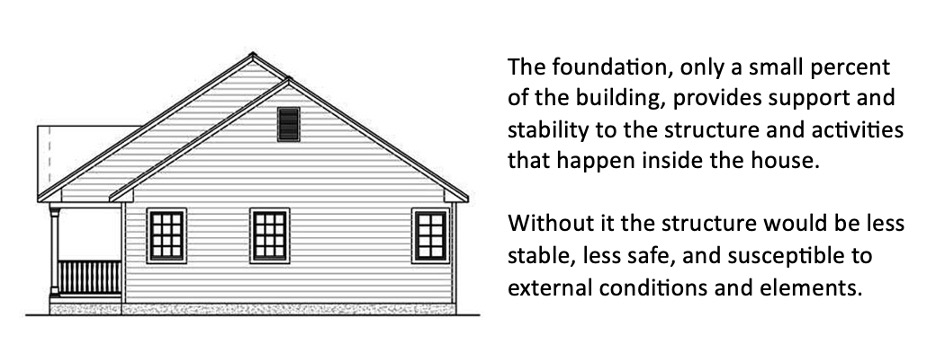
My challenge for you is to prioritize your leadership training as a foundation upon which your career is built. Then put your training into action and share your knowledge with others. This is how we demonstrate the true value of the 70/20/10 rule @ 100%.

The Things We Believe

The Road to Success – Part 3

Leading with Purpose: In my previous posts in The Road to Success series, in The Things We Are section, we looked at a leadership journey from a behavioral framework of how we lead, model, and support others, and in The Things We Carry section, we reflected on the types of baggage that either support our leadership credibility or hold us back. In this post we pause to become more familiar with the engine (our purpose) and the fuel (our beliefs) that keep it running.

Simon Sinek’s Golden Circle Ted Talk challenges us to start by thinking about WHY we do what we do (You can watch it here). The answer we come up with when we start with our “why” frames what we BELIEVE about what we do and guides how we go about doing it. 

In the series Ted Lasso, the poster that Ted placed above the locker room door is just one word – BELIEVE. There is a reason for the emphasis on the word “believe” in both stories. Our beliefs drive our thoughts, and our thoughts influence our attitudes and behaviors. 

Our beliefs show up in how we  perform, act, and respond to the people, situations, and the environment around us. They are the fuel for the engine (our purpose) that drives us forward. What is important here is recognizing that while our beliefs play a key role in our effectiveness as leaders, some of our beliefs may be based on false assumptions or outdated data that can limit us. 

My challenge for you this month is to explore how your purpose is driving you forward by exploring and assessing what you BELIEVE regarding the prompts below. Pay attention to where your beliefs lean toward being positive and affirming or negative and critical.  Also consider if your beliefs are in line with the most recent data, or if they might they be impacted by unsubstantiated assumptions. Be openly curious as you reflect on these areas.

  • What do you believe about your organization? 
    • Do you buy into the vision, mission, and strategic goals? Are they relevant, realistic, and meaningful? Are they keeping up with the times?
    • Do you take pride in the quality of the products and/or services your organization sells/supports? Are they worth your personal recommendation?
    • Are you satisfied with the politics that run your organization? Do you trust the organizations executive leadership? 
    • How would you describe your company’s organizational culture?

If you had the power to change anything based on your current beliefs in this area, what would it be?

  • What do you believe about your employees? 
    (
    Consider this both for each individual and as a team.)
    • Do they show appropriate attitudes, levels of motivation, and engagement? 
    • Do they possess the appropriate knowledge, skills, and abilities to excel in their roles? 
    • Are there available opportunities for further development and growth?
    • Do you trust them enough to delegate critical tasks?
    • Name what you value most about each employee that reports to you. Tell them.
    • Name what concerns you about each employee that reports to you. Coach them.

Believing in those you lead is critical to being effective as a leader. If you had the power to change anything based on your current beliefs about them, what would it be?

  • What do you believe about yourself?
    • What are your strengths as a leader of others?
    • What leadership qualities do you rely on most in your work environment? Why?
    • How effective is your influence with upper management?
    • What do you believe you need to adapt/improve to model the kind of leadership that your employees need to thrive? 
    • What do you believe you need to adapt/improve to model the kind of leadership that your organization needs to thrive? 

If you had the power to change anything based on your current beliefs about yourself as a leader, what would it be?

My hope is that by investing time in this activity you will gain additional clarity and perspective on how exploring what you believe about something, or someone, is an important step in your ongoing development as a respected and effective leader.  

The Things We Carry

The Road to SuccessPart 2

Backpack on office desk with pencil box and books.

In the previous post, we explored the ways that we move through the journey of our careers by visualizing our personal roads to success. In particular, how important it is to pay attention to the road signs that guide the direction of our goals: how we connect with our colleagues, how we treat our passengers and those looking for a ride, and how we respond to the roadblocks and detours we encounter along the way.

Packed and Ready – This post is about what we packed when we first set out on our career paths and what we picked up along the way. In this reflection, the challenge is to think about what things continue to support, energize, and motivate us, and what things are holding us back or weighing us down. What comes to mind for things we carry are our knowledge, skills, abilities, education, and credentials, but, also, our mindset, career plans, references, contacts and, of course, our professional reputations. 

Pack & Purge – These things need to be revisited and reflected upon often to ensure that we actively build and strengthen them. Knowledge can become outdated without ongoing professional development, credentials can become obsolete as industry moves forward (or they can expire), mindsets can be challenged, and plans can change to meet shifting needs.  Our ability to maintain mutually beneficial working relationships keeps our contacts supportive and collaborative, and our professional reputations can both open doors to new opportunities or close them if we stray from our values, lose credibility, or prioritize personal success above all else. 

The roads we have traveled instilled upon us unique formative influences and life experiences, and because the road ahead is both exciting and unknown, our packs also contain things like our hopes and dreams, our imaginations, our goals and intentions, and our gratitude, as well as our triggers, mistakes, anxieties, unconscious biases, and, if we are honest, some regrets and resentment. It’s important to check our personal inventory and decide what is important to keep and what we need to leave behind. Letting go can be challenging, painful, and may even feel disloyal to our egos, but it is an important part of our forward momentum and should never be ignored or avoided. Carrying these things just weighs us down. Lucy Maud Montgomery, a well-known author, sums it up perfectly, “We should regret our mistakes and learn from them, but never carry them forward into the future with us.”

First Aid – There will be times when we hit an unexpected dead end as we travel forward on our chosen career paths. What do we have packed that will get us through the disappointment and frustration when we find we can’t go any further on a specific path?  

The U-Turn – For me, I both welcome and embrace the U-turn because it helps me practice patience and strengthen my resilience and adaptability. Returning to a place we just came from to chart a new course can be a great opportunity to reassess where we want to go and find the un-explored options for how we get there. Sometimes you have to go backwards to move forward! 

Hitchhikers
– A career well-traveled provides opportunities to lift others up along the way. Don’t miss them. It is important to pay our success forward by mentoring those who will follow. We can ensure they are ready by actively involving them in our day-to-day, and by sharing both our knowledge and experience and our successes and failures. This is how we establish continuity for a career well served.

New Horizons – When the current career journey ends or changes, what begins? For those who are looking forward to a new professional path or, even, retirement, the future is waiting to be explored in new ways. This ending takes us right back to where we began in Part 1 where, once again, we can close our eyes and visualize that we are now on a road to a successful and fulfilling new venture. Does the upcoming sign indicate a new role, new place, new activities, new priorities, or, in the case of retirement, personal projects for which we never found the time? This is our story to write. We can enter this new beginning by reflecting on the importance of packing what you need, paying attention to who is on the journey, and allowing grace and gratitude to be your personal travel companions. 

The Things We Are

The Road to Success – Part 1Picture1

Success is not about standing still and looking around at all you have accomplished. Success is about how you keep moving forward through both accomplishments and failures. It’s also about how you lead, model, and support others along the way. How you move and in what direction is up to you. When you see the signs along your road to success, what destinations call you? Visualize that while you are on your own personal road to success you see a road sign ahead. What does it say? Consider the following questions:

  • Who else is on this road with you?
  • Is anyone passing you?
  • Is there anyone in the vehicle with you?
  • Is there anyone looking for a ride or asking for directions?
  • Are there roadblocks, detours, or one-way signs of which you need to be aware?

Watch the Road Signs – These represent the goals (where you want to go and the things you hope to achieve). Your goals help you focus on what you what to achieve but they might change over time.  As you drive toward those goals, remember that you may need to take an exit to go in a new direction. Success is having the flexibility to make the best decisions in the present moment of your journey. You can’t grab onto a new opportunity if your hands are grasped tightly around the comfortable or the status quo. And often there is more than one way to get somewhere!

Pay Attention To The Traffic – These are your colleagues. Some of them you know, some you don’t. Some rely on you, and on some you rely. Everyone is trying to get somewhere, and you are on this stretch of road with them. Do you ever follow behind a friend’s car to get to get to a place you have never been? By following, you are learning the way for the next time. Conversely, when you let others follow you, you are being a leader by providing a guidance system. The trick is in avoiding accidents and making sure that everyone arrives safely.  If you have, or witness, a fender-bender along the way, remember to be gracious no matter who is at fault.

The Passing Lane – Do you ever notice when on a long road trip that you often pass a car and then later notice the same car passing you? Our careers, like our travels, are made of stops and starts. With careers, it’s not about passing; it’s about hitting your stride. Leaders understand that there is a time for the passing lane, a time for the travel lane, and a time for rest stops. Find and appreciate the value of each and model them for others.

Travel Companions – Often in the course of our career we make connections with those who are on the same path. They may rely on you to help them move toward their own destinations. This is where the shared journey helps us to see the road ahead more clearly and where teamwork and innovation thrive. Sharing both the driving and the navigation brings out the best of what everyone has to contribute and makes the journey much more enjoyable and rewarding for all. Someone may be going your way and just need a lift or help fixing a flat. Do you have it in you to help out even if it slows you down a bit? Are you willing to go the extra mile for them? Their success may turn out to be yours as well so lend a hand whenever you can. 

Roadblocks & Detours – Do they motivate or discourage you? It is important to remember that how you respond to the day-to-day challenges on your road to success is a key factor in how far you get and how long it takes you to get there. Leadership relies on the quality of your character, integrity, and professionalism, and is most apparent to others when the roads are bumpy and the weather overcast.

It’s About the Journey – Success is not where you end up; it’s where you are right now and what you do with it. The measure of success is not how far you have come or how far you plan to go, but in who you are and how you are each mile along the way. It is equal measure how you see yourself and how others see you, how you are getting there, and how you are helping others get there too!

Next, we will discover what motivates, supports, and sustains us and our teams. We will take a critical look at what we have packed for the journey, and how it can help – or hinder – our progress and the progress of those we lead!